Where Are They Now Vol. 3 | ESA Advances Earth Observation for a Resilient Planet

"Where Are They Now" is our continuing spotlight series celebrating the achievements of SPACEtalks alumni and partners shaping the future of space science, innovation, and sustainability.
In this edition, we reconnect with Dr Mark R. Drinkwater, Senior Advisor for Earth Observation Programmes at the European Space Agency (ESA), who recently retired after an extraordinary 25-year career dedicated to advancing Europe’s Earth Observation capability.
Have there been any major milestones or breakthroughs in your work or research recently?
Since the SpaceTalks meting in February the following new missions have been added to the Earth Observation landscape.
Key take-aways: three major European launches achieved (BIOMASS, MTG-S1 and MetOp-SG A1 satellites) reinforcing ESA’s leadership in climate monitoring, carbon accounting, and weather forecasting.
Meanwhile, the HydroGNSS and Copernicus Sentinel-1D and -6B mission preparations are on track for late 2025 launches.
BIOMASS – ESA’s Forest Mission
ESA’s BIOMASS Earth Explorer mission was successfully launched on 29 April from Kourou, French Guiana on a Vega-C launch vehicle.
BIOMASS is a landmark for forest carbon monitoring, as the first-ever spaceborne P-band Synthetic Aperture Radar (SAR) mission specifically designed to measure global forest biomass and carbon stocks. The all-weather polarimetric, interferometric SAR enables provides imaging through the forest canopy, enabling unique 3D mapping of forest biomass density and tree height to reduce uncertainties in the global carbon cycle. The resulting data can be used to support climate and carbon-cycle models and international agreements (e.g., Paris Agreement).
Notably, UK scientists and the UK space industry played a leading role in the design and development of the BIOMASS mission, making it one of the most significant UK contributions to an ESA Earth Explorer mission.

Status: The BIOMASS large 12 metre diameter antenna was deployed in May and the first radar images were released in June (*See here: ESA - Biomass satellite returns striking first images of forests and more). Currently the commissioning phase calibration and validation is ongoing.
Further details about the mission can be found in the infographic here: About Biomass and here.
Meteosat Third Generation Sounder 1 (MTG-S1)
On 1 July Europe took a major step forward in strengthening resilience to extreme weather events with the successful launch of the geostationary Meteosat Third Generation Sounder 1 (MTG-S1), which also hosts the Copernicus Sentinel-4 mission.

The satellite, developed in partnership between the EUMETSAT, the European Space Agency (ESA) the European Commission, and various national meteorological services and industry, is designed to strengthen Europe’s ability to detect and respond to extreme weather events like storms, floods, and heatwaves.
MTG-S1 is the first geostationary sounder platform in the series of pairs of imaging (I) and sounding (S) satellites, and joins MTG-I1 geostationary satellite launched in December 2022. The payload comprises the Infrared Sounder (IRS) and the Copernicus Sentinel-4 instruments. IRS scans ~2,000 thermal infrared wavelengths every 30 minutes to build vertical profiles of temperature, humidity, and trace gases; whilst Copernicus Sentinel-4 provides hourly data on pollutants and aerosols, supporting air quality forecasts and environmental policy.
Together they offer a space-based view of the full lifecycle of convective storms over Europe, from early instability to dissipation in support of nowcasting, daily weather forecasting and climate monitoring. In turn the observations should lead to earlier and more accurate weather warnings, improving public safety and emergency response, as well as enhanced air quality tracking, including emissions from wildfires and volcanic eruptions.
MetOp-SG A1 & Sentinel-5 – Next-Generation Weather & Air Quality Monitoring
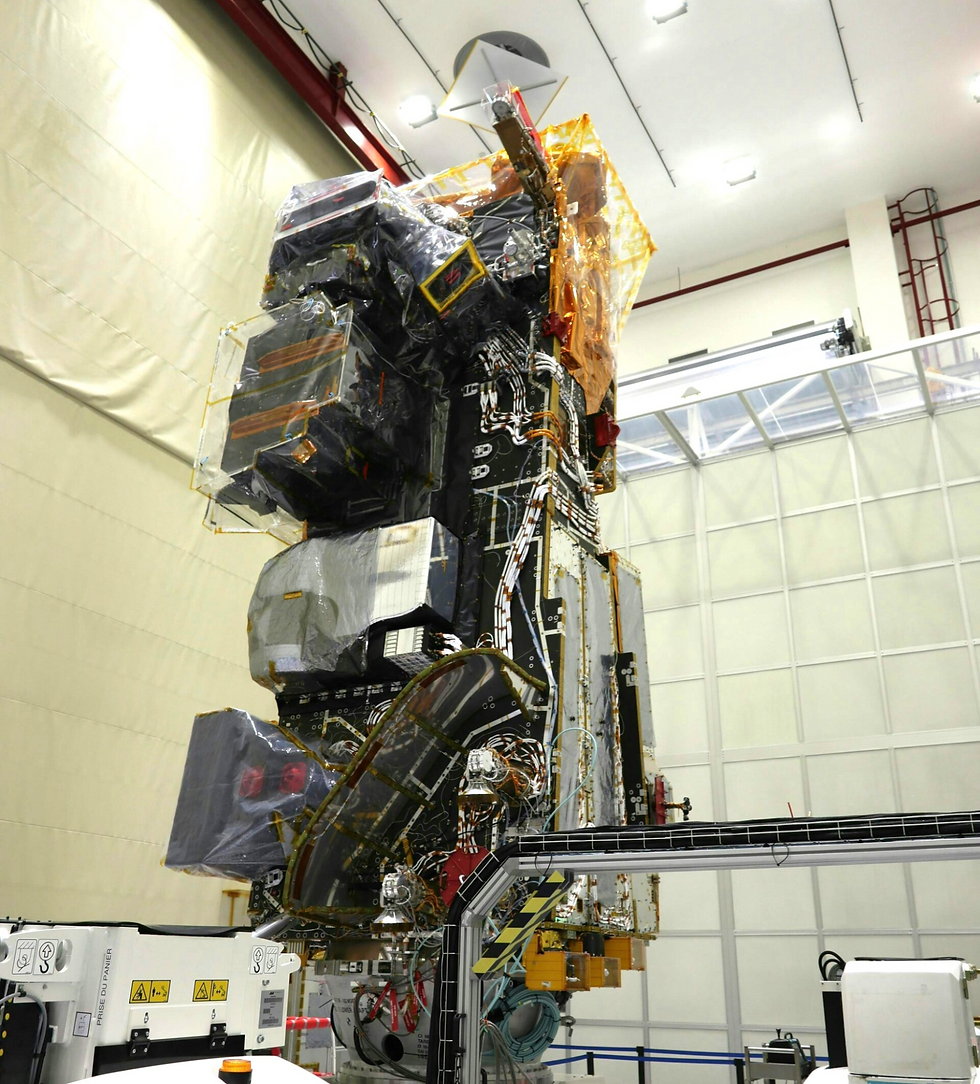
On 13 August – the MetOp-Second Generation A1 (MetOp-SG A1) satellite was successfully launched on Ariane 6 from Kourou, French Guiana. The satellite carries a payload comprising six instruments, including the Copernicus Sentinel-5 spectrometer for atmospheric composition.
The MetOp Second Generation A1 satellite is the first in a series of three successive pairs of satellites, and is designed to improve weather forecasts by providing more detailed data to support national meteorological prediction systems. Each MetOp-SG pair is made up of an A and B satellite carrying different, complementary payloads. Together they total 10 different instruments across both satellites. The A satellites carry six instruments: a next-generation infrared atmospheric sounder (IASI-NG), a microwave sounder (MWS), a multispectral imaging radiometer (METImage), a novel multiviewing, multichannel, multipolarisation imager (3MI), a radio occultation sounder (RO) which is also embarked on the MetOp-SG-B satellites, and the Copernicus Sentinel-5 UVNS spectrometer(operating in the Ultravoilet, Visible, Near infrared and Short-wave infrared), developed by ESA on behalf of the European Commission.
Over the last decade, ESA has been responsible for the design and development of the MetOp satellites, while the European Organisation for the Exploitation of Meteorological Satellites (EUMETSAT) manages the launch services, ground segment development, satellite operations and distribution of data to the meteorological community. After in-orbit commissioning the satellite will be operated by EUMETSAT.
Improvements gained from harnessing the insights provided by this satellite’s instruments, will enable numerical weather prediction models to predict high-impact weather events earlier. These data are vital to enhancing global weather forecasting and climate monitoring, and for protecting infrastructure and the economy, and for saving lives for the next 20+ years.
Can you share any updates on the project or idea you discussed during SPACEtalks?
HydroGNSS – Preparing for Launch
ESA’s first Scout-class Earth observation research mission HydroGNSS recently completed its Flight Acceptance Review (in August) and its launch is scheduled in Q4 2025 on Falcon-9 (see: ESA - HydroGNSS passes Flight Acceptance Review). The HydroGNSS twin satellite combination employs reflectometry, capturing reflected L-band signals from the constellation of Global Navigation Satellite System (GNSS). The objectives of the mission are to measure soil moisture, permafrost freeze–thaw, wetlands, and biomass.
Copernicus Programme Progress
The launch of Sentinel-1D is scheduled in Q3 2025 on Vega-C to strengthen the Copernicus radar imaging constellation for land and maritime monitoring.
The launch of the Sentinel-6B altimeter-based precision sea-level monitoring mission is scheduled for Q4 on Falcon-9.
Ongoing Earth Explorer Contributions
ESA’s SMOS, CryoSat, Swarm, EarthCARE Explorer missions in operation continued delivery of critical datasets on soil moisture, ocean salinity, polar ice, Earth’s magnetic field, and clouds, aerosols and radiation.
What’s something you’ve accomplished recently that you're particularly proud of?
ESA hosted the largest ever Living Planet symposium in June, which showcased European Earth observation science. The 7300 registered participants demonstrated fantastic growth and interest in the EO arena:
Registered participants: 7300 with a 45% increase compared to LPS22
Participants in presence: 6903 with a 58% increase compared to LPS22
Number of students: 2300 – 450% increase compared to LPS22
EO industry sponsors: 57 vs 45 at LPS22
Participants from 125 nationalities
Number of scientific presentations & posters: 4200+
Number of overall presentations: > 5000
Number of oral sessions: >250
Number of Agoras: 60
Number of capacity building sessions (tutorials,hands-on & demos): >150
Number of plenaries: 6
Number of side events: 13
Total number of sessions: nearly 500
Is there anything else you’d like to share with the community or highlight?
I will officially retire from ESA on 1 October. After a career spanning 4 years research and consultancy, 14 years working as research scientist at NASA Jet Propulsion Laboratory, and period of 25 years in management at ESA, this adds up to over 40 years working in the Earth Observation sector.
As ESA continues pushing scientific boundaries with new Earth observation missions, Mark’s work serves as a reminder that progress in space is built on persistence, collaboration, and decades of expertise.
We thank Mark for sharing these updates with the SPACEtalks community, and wish him all the best as he transitions into a new chapter beyond ESA.
Stay tuned for more stories from the SPACEtalks community, where decades of innovation in orbit continue to shape a sustainable future on Earth.

Comments